
 India's DMPLOI - Jobs & Networking App
Lyfius Pharma Announces Walk-in Drive for API Division in Kakinada
Aurobindo Pharma’s subsidiary opens doors for biotechnology professionals in greenfield project
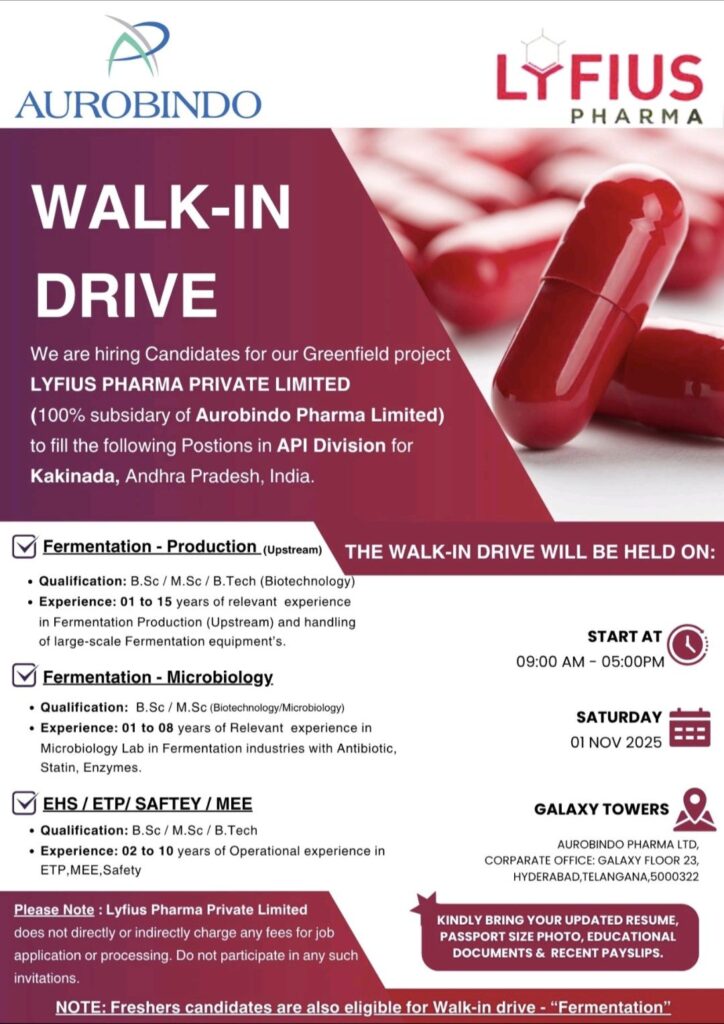
Hyderabad, India – Lyfius Pharma Private Limited, a wholly-owned subsidiary of Aurobindo Pharma Limited, is set to host a walk-in recruitment drive for its API (Active Pharmaceutical Ingredient) Division. The drive aims to support the company’s new greenfield project in Kakinada, Andhra Pradesh, offering opportunities across multiple roles in fermentation, microbiology, and environmental health and safety.
Event Details
Date: Saturday, November 1, 2025
Time: 9:00 AM – 5:00 PM
Venue: Galaxy Towers, Aurobindo Pharma Ltd, Corporate Office, Galaxy Floor 23, Hyderabad, Telangana, 5000322
Available Positions
1. Fermentation – Production (Upstream)
Qualifications: B.Sc / M.Sc / B.Tech (Biotechnology)
Experience: 1 to 15 years in fermentation production (upstream) and handling of large-scale fermentation equipment.
2. Fermentation – Microbiology
Qualifications: B.Sc / M.Sc (Biotechnology/Microbiology)
Experience: 1 to 8 years in microbiology labs within fermentation industries, particularly with antibiotics, statins, and enzymes.
3. EHS / ETP / Safety / MEE
Qualifications: B.Sc / M.Sc / B.Tech
Experience: 2 to 10 years of operational experience in ETP (Effluent Treatment Plant), MEE (Multiple Effect Evaporator), and safety protocols.
Key Highlights
· Freshers Welcome: The company has explicitly stated that freshers are eligible to apply for fermentation roles, making this an excellent entry point for recent graduates.
· No Fees Charged: Lyfius Pharma emphasizes that it does not charge any fees for job applications or processing. Candidates are advised to avoid any intermediaries or platforms requesting payment.
· Required Documents: Candidates should bring an updated resume, passport-sized photographs, educational certificates, and recent payslips (if applicable).
About the Project
The greenfield project in Kakinada represents a significant expansion for Aurobindo Pharma in the API manufacturing space. As the demand for pharmaceutical ingredients grows, this state-of-the-art facility aims to strengthen the company’s production capabilities and contribute to India’s position as a global pharmaceutical hub.
A Word for Aspirants
This walk-in drive offers a unique opportunity for professionals and freshers alike to join a reputed organization with a legacy of excellence. With roles spanning production, microbiology, and environmental safety, the drive caters to a wide range of skill sets and experience levels.
Interested candidates are encouraged to attend the walk-in interview with all necessary documents and seize this chance to be part of a dynamic and growing team.
FAQ:
1. What is the difference between upstream and downstream processes in fermentation?
Answer:
Upstream process involves all steps leading to cell growth and product formation, including media preparation, sterilization, inoculum development, and fermentation.
Downstream process includes cell separation, purification, concentration, and drying to obtain the final product.
At Lyfius Pharma, upstream experience includes operating bioreactors, air sparging systems, and monitoring DO (Dissolved Oxygen) & pH control systems.
2. What are key parameters monitored during fermentation?
Answer:
Critical parameters include:
Temperature – optimal for microbial growth
pH – maintained using acid/base addition
Dissolved Oxygen (DO) – regulated by aeration and agitation speed
Agitation Speed – ensures homogeneous mixing
Foam Control – antifoam agents or mechanical breakers used
Real-time monitoring and control through SCADA or DCS systems are essential for consistent batch performance.
3. What are common microorganisms used in industrial fermentation for API production?
Answer:
Commonly used strains include:
Streptomyces species – for antibiotics (e.g., erythromycin, streptomycin)
Aspergillus niger – for enzyme and citric acid production
E. coli or Saccharomyces cerevisiae – for recombinant protein or enzyme production
Selection depends on yield, productivity, and genetic stability of the strain.
4. How is safety maintained in ETP (Effluent Treatment Plant) and MEE (Multiple Effect Evaporator) operations?
Answer:
Regular monitoring of pH, COD, and TDS levels in effluent streams
Use of personal protective equipment (PPE) and adherence to SOPs
Closed handling systems to avoid exposure to hazardous vapors
Proper steam and condensate management in MEE units
Routine safety audits and waste segregation in line with CPCB guidelines
5. What are common contamination control measures in fermentation and microbiology labs?
Answer:
HEPA-filtered clean air supply in critical areas
Sterilization of media and equipment using autoclaves or SIP (Steam-in-Place)
Laminar airflow cabinets for aseptic handling
Routine microbial monitoring of environment and personnel
Strict segregation of production and lab areas to prevent cross-contamination