 India's DMPLOI - Jobs & Networking App
Piramal Pharma Limited Announces Walk-In Interviews for Production Roles in Pithampur
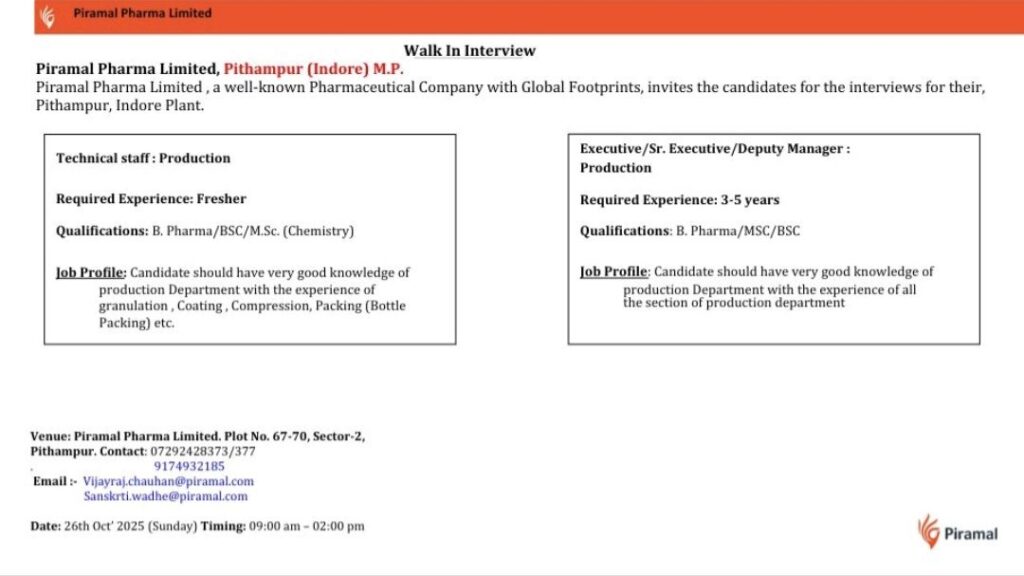
Pithampur, Indore – Piramal Pharma Limited, a pharmaceutical giant with a significant global presence, has announced a walk-in recruitment drive for its production unit in Pithampur, Indore. The event is scheduled for Sunday, October 26, 2025, and aims to fill multiple positions, ranging from entry-level technical staff to experienced managerial roles.
This initiative presents a valuable opportunity for both fresh graduates and seasoned professionals in the pharmaceutical manufacturing sector to join a reputed industry leader.
Open Positions and Eligibility
The company is actively recruiting for the following two primary roles within its production department:
1. Technical Staff: Production
Required Experience: Freshers are encouraged to apply.
Qualifications: B. Pharma, B.Sc., or M.Sc. in Chemistry.
Job Profile: The ideal candidate will have a strong understanding of production processes, including hands-on knowledge or training in key areas such as granulation, coating, compression, and bottle packing.
2. Executive/Sr. Executive/Deputy Manager: Production
Required Experience: 3 to 5 years in a relevant production environment.
Qualifications: B. Pharma, M.Sc., or B.Sc.
Job Profile: Candidates are expected to possess in-depth knowledge and practical experience across all sections of a pharmaceutical production department, demonstrating the capability to handle supervisory or managerial responsibilities.
Interview Details at a Glance
Date: 26th October 2025 (Sunday)
Time: 9:00 AM to 2:00 PM
Venue: Piramal Pharma Limited, Plot No. 67-70, Sector-2, Pithampur, Indore, Madhya Pradesh.
How to Apply?
Interested and eligible candidates are requested to attend the walk-in interview at the specified venue and time. It is recommended to bring multiple copies of an updated resume, all relevant educational certificates, experience letters, and a government-issued photo ID.
For further inquiries, prospective applicants can contact:
Phone: 07292428373 / 07292428377
Email: Vijayraj.chauhan@piramal.com / Sanskrti.wadhe@piramal.com
About Piramal Pharma Limited
Piramal Pharma Limited is a well-established name in the pharmaceutical industry, known for its extensive global footprint and commitment to quality and innovation. The company’s Pithampur plant is a key manufacturing unit, making this a significant career opportunity for those looking to advance in the pharmaceutical manufacturing field.
This walk-in interview is a direct pathway to become part of a dynamic team at a leading global enterprise. Candidates are advised to arrive prepared to make a strong impression.
FAQ:
1. What are the major steps involved in tablet manufacturing?
Answer:
Tablet manufacturing typically involves the following key stages:
Dispensing: Measuring and weighing raw materials as per the batch manufacturing record (BMR).
Granulation: Converting fine powders into granules to improve flow and compression characteristics.
Drying: Removing moisture from granules to achieve the desired LOD (Loss on Drying).
Blending: Mixing active ingredients with excipients uniformly.
Compression: Compressing the blended material into tablets.
Coating & Packing: Applying film or sugar coating and then packing in bottles, blisters, or strips.
2. What is the difference between wet granulation and dry granulation?
Answer:
Wet Granulation: Uses a granulating fluid (like purified water or PVP solution) to form granules, followed by drying.
Advantages: Improves compressibility and content uniformity.
Example: Used for moisture-tolerant and heat-stable drugs.
Dry Granulation: Involves compacting powder into slugs or ribbons and then milling into granules, without using liquid.
Advantages: Suitable for moisture-sensitive or heat-labile drugs.
3. What critical parameters are controlled during the coating process?
Answer:
Key parameters include:
Inlet air temperature – Controls drying efficiency.
Spray rate and atomization air pressure – Ensure uniform coating.
Pan speed – Maintains even film distribution.
Exhaust air temperature – Prevents overwetting or peeling.
Coating solution viscosity – Affects smoothness and film thickness.
4. What are common deviations or issues faced in production and how are they managed?
Answer:
Common deviations include:
Weight variation – Controlled by adjusting granule flow and feeder speed.
Capping or lamination – Prevented by optimizing compression force and moisture content.
Sticking/picking during coating – Managed by controlling temperature and spray rate.
Hardness variation – Adjusting compression pressure and granule size distribution.
Deviation management involves documentation, root cause analysis (RCA), corrective and preventive actions (CAPA), and approval from QA.
5. What are GMP (Good Manufacturing Practice) guidelines important in production?
Answer:
GMP ensures consistent production quality and safety. Key principles include:
Proper documentation – BMR, BPR, SOP compliance.
Hygiene and cross-contamination control.
Equipment calibration and qualification.
Environmental monitoring and control.
Personnel training and safety practices.
Adhering to GMP minimizes errors and ensures regulatory compliance with WHO, USFDA, or EU standards.