 India's DMPLOI - Jobs & Networking App
Aculife Healthcare Announces Walk-In Interviews for R&D Roles in Sterile Injectable Manufacturing
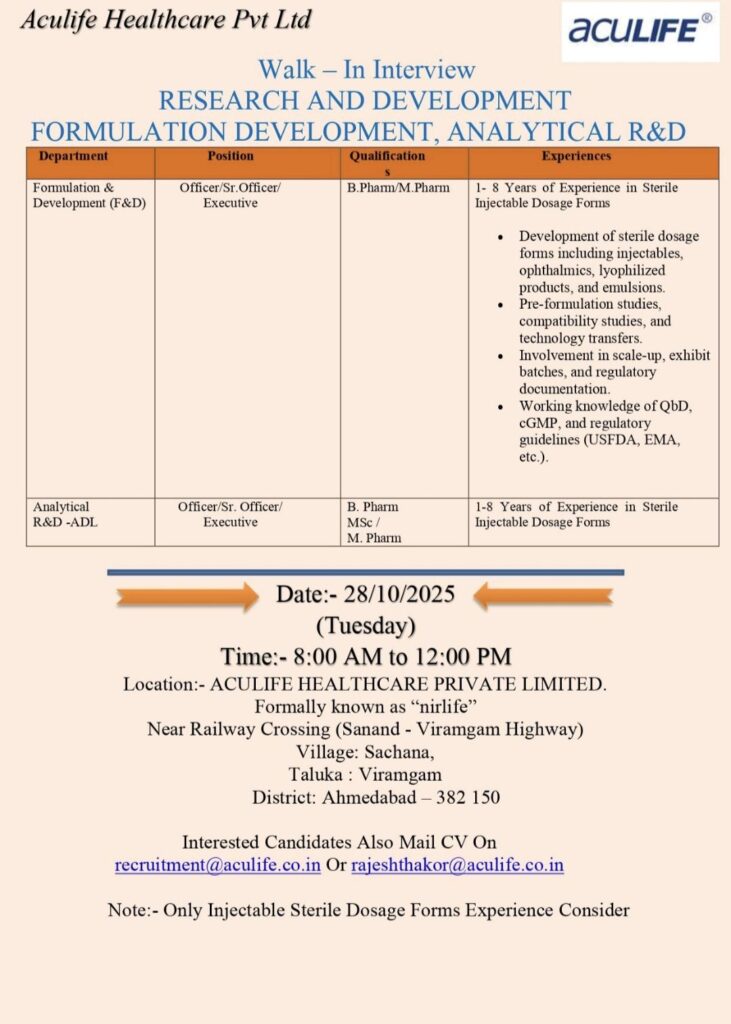
Ahmedabad, October 2025 – Aculife Healthcare Private Limited, a prominent player in the pharmaceutical industry, has announced a walk-in recruitment drive for experienced professionals in its Research and Development (R&D) division. The company is seeking talented individuals to join its Formulation Development and Analytical R&D teams, with a specific focus on sterile injectable dosage forms.
Scheduled for Tuesday, October 28, 2025, this event presents a significant opportunity for qualified candidates with backgrounds in pharmaceutical sciences to advance their careers with a company dedicated to advanced drug delivery systems.
Available Positions and Eligibility
Aculife Healthcare is looking to fill multiple roles at the Officer, Senior Officer, and Executive levels. The detailed requirements for each department are as follows:
1. Formulation & Development (F&D)
Qualifications: B.Pharm / M.Pharm
Experience: 1 to 8 years in Sterile Injectable Dosage Forms.
· Required Expertise:
· Development of sterile products, including injectables, ophthalmics, lyophilized products, and emulsions.
· Conducting pre-formulation and compatibility studies.
· Managing technology transfer processes.
· Involvement in scale-up activities, exhibit batches, and regulatory documentation.
· Working knowledge of Quality by Design (QbD), current Good Manufacturing Practices (cGMP), and regulatory guidelines (USFDA, EMA, etc.).
2. Analytical R&D (ADL)
Qualifications: B.Pharm / M.Sc / M.Pharm
Experience: 1 to 8 years in the analysis of Sterile Injectable Dosage Forms.
The company has explicitly stated that only candidates with experience in injectable sterile dosage forms will be considered, underscoring the specialized and critical nature of these roles.
Interview Details at a Glance
Date: Tuesday, October 28, 2025
Time: 8:00 AM to 12:00 PM
Venue: Aculife Healthcare Private Limited
(Formally known as “nirlife”)
Near Railway Crossing, Sanand – Viramgam Highway,
Village: Sachana, Taluka: Viramgam,
District: Ahmedabad – 382150
How to Apply?
Interested and eligible candidates have two options:
1. Attend the walk-in interview directly at the specified venue, date, and time.
2. Send their CV in advance via email to recruitment@aculife.co.in rajeshthakor@aculife.co.in.
1) What data package is expected from F&D before Technology Transfer (TT)?
Answer:
Prepare a complete TT dossier covering:
QbD summary: QTPP, CQA list, risk assessment (FMEA/Ishikawa), initial design space & control strategy.
Formulation rationale: excipient selection/levels (buffer, tonicifier, antioxidant/chelators, surfactant), sterilization approach (terminal vs aseptic), and container-closure compatibility.
Process description: mixing order, hold times, filtration scheme (0.22 μm sterilizing filter), filter compatibility & integrity limits, depyrogenation approach, lyophilization cycle (if applicable).
Development studies: pre-formulation, compatibility (drug–excipient, diluents, IV sets), in-use stability, freeze–thaw & photostability.
Master documents: draft BMR/BPR, manufacturing formula, bill of materials, sampling/IPC plan.
Stability: initial ICH protocols, specifications, and ongoing study status.
Regulatory-ready exhibits: deviations, CAPA history, and lessons learned.
2) How are compatibility & stability studies for sterile injectables typically designed?
Answer:
Compatibility: pH/salt screening, excipient compatibility, adsorption/interaction with filters, tubing, and infusion bags/sets; sorption studies for low-dose actives.
In-use stability: common diluents (e.g., 0.9% NaCl, 5% dextrose), typical concentrations, storage times/temperatures, and light protection needs.
Stress studies: thermal (accelerated), photostability, freeze–thaw, agitation (emulsions/suspensions).
Critical tests: assay/impurities, pH, osmolality/tonicity, sub-visible particulate matter (per USP <788>), visible particles, CCI (where relevant), reconstitution time (lyophilized), droplet/particle size for emulsions/suspensions.
ICH stability: long-term, intermediate, accelerated conditions with predefined acceptance criteria and stability-indicating methods.
3) Which analytical techniques should ADL candidates be comfortable with for sterile dosage forms?
Answer:
Chromatography: HPLC/UPLC (assay, related substances) with UV/PDA/FLD; GC for residual solvents; LC–MS for ID/trace impurities when needed.
Wet chemistry/physicochemical: KF water content, pH, osmolality, viscosity.
Elemental/trace: ICP-MS/OES (if required by product).
Particulates/appearance: sub-visible particulate testing (HIAC/LI), visual inspection, clarity/color.
Extractables/Leachables: plan & screening with suitable detectors.
Micro co-ordination: awareness of sterility (USP <71>), endotoxin/BET (USP <85>), bioburden—execution typically by Micro but ADL coordinates acceptance criteria & sample handling.
Validation: per ICH Q2—specificity, accuracy, precision, linearity, range, LOD/LOQ, robustness; system-suitability & lifecycle (transfer, verification).
4) How is QbD applied in sterile product development at Aculife?
Answer:
Define QTPP (route, dosage, container, shelf-life, storage).
List CQAs (potency, impurities, pH, osmolality, particulate levels, sterility assurance, CCI, reconstitution time, droplet/particle size).
Map CPPs/CMAs: mixing speed/time, temperature, filtration ΔP, filter type, nitrogen overlay, lyophilization steps (FP, anneal, PD, SP), fill volume/speed, stopper venting, sterilization cycle.
DoE studies to establish edges of failure/design space (e.g., excipient ranges, cycle parameters).
Control strategy: IPCs, release tests, environmental and aseptic controls aligned to Annex 1/US guidance.
Knowledge management: traceability from development reports → exhibit batch justifications → PPQ readiness.
5) What are the expectations for scale-up and exhibit/engineering batches for sterile injectables?
Answer:
Scaling rules: maintain key dimensionless numbers (e.g., tip speed/mixing regimes), shear profile, and heat-transfer considerations; verify hold times and O2 exposure.
Filtration & sterilization: scale filter area & flow rates; pre/post integrity tests (bubble point/pressure-hold) with acceptance criteria; terminal sterilization F₀ mapping if applicable.
Lyophilized products: translate lab cycle to commercial lyophilizer (load pattern, shelf heat-transfer, condenser capacity); use thermal mapping and product thermocouples/pirani for endpoint.
Aseptic operations: line compatibility, fill accuracy, stopper/spray settings; coordination of media fills (performed by manufacturing/QA) with R&D support for worst-case scenarios.
Documentation: exhibit batch protocols, change controls, TT reports, comparability assessments, and data package suitable for regulatory submissions.